Cold email has changed significantly over the last few years. As Microsoft and Google continue tightening sender reputation requirements, businesses can no longer rely on aggressive mass-email strategies and expect consistent results. Deliverability, sender reputation, bounce rates, and inbox health now play a major role in outbound performance.
This is why inbox rotation for cold email has become increasingly important.
At Sequence-R, we built our inbox rotation system not simply to help users send more emails, but to help businesses scale outbound activity more intelligently while protecting long-term deliverability.
In this article, we’ll explain what inbox rotation for cold email is, why it matters, and how Sequence-R’s smart rotation feature helps businesses maintain healthier sending infrastructure.
What Is Inbox Rotation for Cold Email?
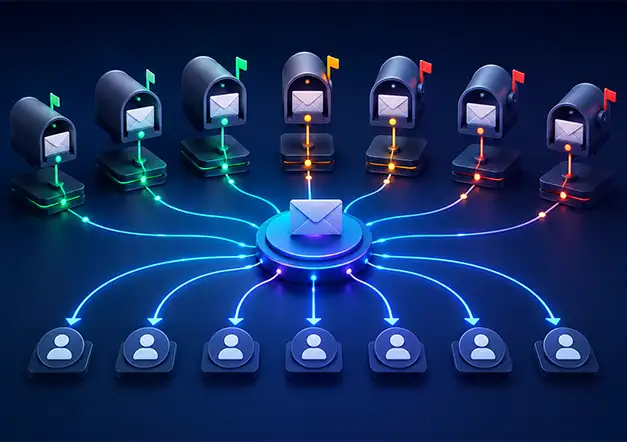
Inbox rotation for cold email is the process of distributing outbound emails across multiple sender inboxes instead of relying on a single mailbox.
Rather than sending every campaign email from one account, a cold email platform rotates sending activity between several connected inboxes. For example, instead of sending 200 emails from a single Outlook account, a campaign could distribute activity across five inboxes sending 40 emails each.
This creates a more natural sending pattern and reduces pressure on individual accounts.
Inbox rotation for cold email has become increasingly common because mailbox providers such as Microsoft and Google monitor sender behaviour much more closely than they did in the past. Sudden increases in email volume, poor engagement, or high bounce rates can negatively affect sender reputation surprisingly quickly.
Why Inbox Rotation Matters
One of the biggest misconceptions around inbox rotation for cold email is that its only purpose is to increase sending volume.
While inbox rotation can absolutely support larger outbound operations, the real value is much more strategic.
Proper inbox rotation helps businesses maintain healthier deliverability by distributing activity naturally across multiple accounts. This reduces the likelihood of individual inboxes becoming overloaded and helps create a more sustainable outbound infrastructure over time.
Cold email today is no longer simply about “how many emails can we send?”. Modern outbound strategies are increasingly focused on long-term inbox health, engagement quality, and consistency.
A campaign generating meaningful conversations consistently is far more valuable than one sending huge volume with poor inbox placement.
The Risks of Overloading Individual Inboxes
Without inbox rotation for cold email, businesses often place too much pressure on individual accounts without realising the long-term impact.
When one inbox begins sending too aggressively, experiences high bounce rates, or receives poor engagement signals, its reputation can weaken quickly. Once an inbox starts landing in spam folders regularly, campaign performance usually declines significantly. Open rates decrease, reply rates drop, and sender trust becomes harder to rebuild.
This is one reason why many outbound teams struggle despite continuously increasing their sending volume.
More emails do not automatically create better results.
How Sequence-R Smart Rotation Works
At Sequence-R, we wanted to build a more intelligent approach to inbox rotation for cold email.
Many traditional rotation systems simply rotate equally between inboxes without considering inbox health or actual performance. The problem is that inboxes rarely perform identically. Some accounts maintain excellent deliverability while others may begin showing early warning signs of reputation issues.
That’s why Sequence-R includes smart rotation.
Instead of distributing sending volume equally at all times, our system dynamically adjusts campaign activity based on inbox health indicators.
One of the signals monitored by Sequence-R is spam placement inside the warmup pool environment. If an inbox begins showing signs of weaker deliverability or increased spam placement during warmup activity, the platform can automatically reduce the amount of campaign traffic assigned to that inbox.
Bounce rate monitoring also plays an important role.
High bounce rates can negatively affect domain reputation and increase the risk of future spam placement. Sequence-R monitors bounce performance across campaigns and uses this information as part of the rotation logic. If an inbox begins generating excessive bounce activity, smart rotation can reduce sending volume for that account while healthier inboxes safely handle slightly more campaign activity.
The result is a more adaptive and intelligent outbound infrastructure.
Rather than treating every inbox the same way, Sequence-R continuously adjusts activity levels based on real deliverability and performance signals.
Inbox Rotation Is Not About Spamming
It is important to understand that inbox rotation for cold email should never be viewed as a tool designed purely for spam or aggressive mass-email behaviour.
At Sequence-R, we believe successful outbound campaigns are built around good targeting, relevant messaging, proper infrastructure, and controlled sending practices.
Inbox rotation simply helps businesses manage outbound activity more responsibly.
In many cases, relatively modest sending volumes can generate excellent results when deliverability remains healthy and targeting is strong. Businesses often achieve better long-term outcomes from controlled, sustainable outbound campaigns than from highly aggressive volume-focused strategies.
The Future of Cold Email Infrastructure
Mailbox providers are becoming increasingly sophisticated in how they evaluate outbound behaviour and sender reputation. As a result, cold email infrastructure also needs to evolve.
Inbox rotation for cold email is no longer just an advanced feature for large outbound teams. It is becoming an essential part of maintaining healthy and sustainable outreach operations.
At Sequence-R, we believe the future of outbound belongs less to aggressive mass sending and more to intelligent infrastructure designed around inbox health and deliverability.
Our smart rotation feature was built with exactly that philosophy in mind.
Instead of focusing purely on sending more emails, Sequence-R focuses on helping businesses scale outbound campaigns responsibly while protecting long-term sender reputation.