Many B2B teams assume that if a sequence is technically correct, replies will eventually follow. Emails are sent, follow-ups are scheduled, open rates look acceptable, yet inboxes remain silent. This leads to frustration and often the wrong conclusion that email sequencing no longer works.
In reality, email sequences still work extremely well in B2B. The issue is rarely the channel itself. More often, it is how email sequencing is designed, executed, and managed over time.
Below are seven of the most common reasons email sequences do not get replies, even when using good email sequencing software.
1. Your Email Sequence Has No Real Trigger
One of the biggest mistakes in sequencing is sending emails simply because a list exists. Many sequences are built around availability rather than relevance.
A sequence without a clear trigger feels random to the recipient. Decision makers reply when an email connects to a current situation, pressure, or priority. Without that context, even well-written emails are easy to ignore.
Effective email sequences are anchored to something concrete. A change in the prospect’s environment, a common industry issue, a growth phase, or a known operational challenge. When an email sequence lacks a reason to exist at that moment, replies drop sharply.
2. You Are Optimising for Opens Instead of Replies
Open rates are one of the most misleading metrics in email sequencing. A subject line can generate opens without creating any real interest in a conversation.
Many email sequences are written to maximise curiosity rather than relevance. They get opened but fail to move the reader forward. The message feels vague, generic, or incomplete, so the prospect closes the email without responding.
Replies happen when the body of the email answers a silent question in the reader’s mind. Why this matters to me, right now. Email sequencing should be optimised for response quality, not surface-level engagement.
3. Your Follow-Ups Add No New Information
Follow-ups are where most sequences fail. Many sequences simply repeat the same message with slightly different wording. From the recipient’s perspective, nothing new is being offered.
A good follow-up changes the angle. It introduces a new insight, a different use case, or a clearer framing of the problem. Each step in an email sequence should earn its place.
When follow-ups feel automated or repetitive, recipients mentally label the sequence as noise. Once that happens, replies stop completely.
4. Your Email Sequencer Is Over-Automated
Automation is useful, but over-automation is destructive. Many teams rely on their email sequencer to do the thinking for them. Every prospect receives the same timing, the same spacing, and the same structure.
Real conversations are not linear. Some prospects need fewer touches, others need more time. Some should be paused, others prioritised. Rigid email sequencing ignores these signals.
Email sequencing software should support judgement, not replace it. When sequences run without human intervention or adjustment, reply rates tend to plateau quickly.
5. You Are Targeting Roles, Not Situations
Another common issue with sequences is shallow targeting. Campaigns are often built around job titles rather than real-world responsibilities and pressures.
Two people with the same title can have completely different priorities depending on company size, market, and internal structure. When email sequences ignore this nuance, messages feel disconnected from reality.
High-performing sequences focuses on situations rather than labels. It speaks to what the prospect is likely dealing with, not just what appears on their LinkedIn profile or database record.
6. Your Sequence Ignores Deliverability Signals
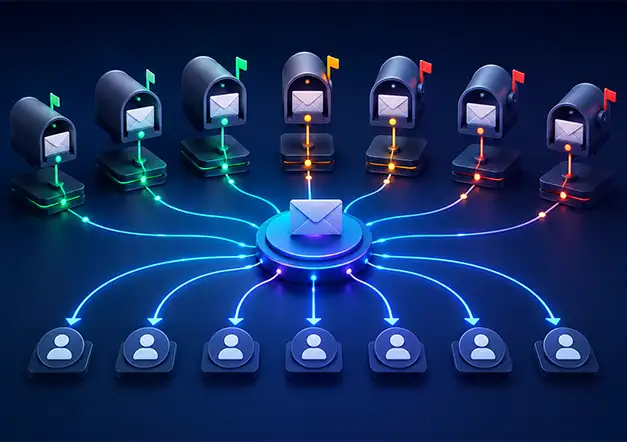
Many teams assume that if emails are being sent, they are being received. In reality, deliverability issues often suppress replies long before emails stop landing altogether.
Poor domain reputation, inconsistent warm-up, aggressive sending patterns, and low engagement all affect how inbox providers treat your emails. Even when emails technically arrive, they may be deprioritised or filtered in subtle ways.
Email sequencing and deliverability are closely linked. A sequence that sends too fast, too often, or without engagement feedback will slowly damage its own performance. This results in fewer replies over time, even if the content remains unchanged.
7. Your Email Sequence Tries to Sell Too Early
One of the fastest ways to kill replies is pushing for a sale before a conversation exists. Many email sequences jump straight to demos, pricing, or meetings without establishing relevance or trust.
In B2B, replies are often exploratory. Prospects respond when they feel understood, not when they feel pressured. Sequences that lead with curiosity and clarity consistently outperform those that lead with offers.
Email sequencing works best when the initial goal is dialogue, not conversion. Once a reply happens, progression becomes much easier.
Final Thoughts
If your email sequences are not getting replies, it does not mean email sequencing is broken. It usually means the sequence is misaligned with how decision makers actually think and respond.
Effective email sequencing is intentional, situational, and disciplined. It balances automation with judgement, structure with flexibility, and persistence with relevance.
Before changing tools or abandoning email altogether, it is worth auditing your sequences through this lens. In many cases, small strategic adjustments lead to significant improvements in reply rates, without increasing volume or complexity.
Email sequencing still works. It just requires more thought than most teams are willing to give it.